You've had crispy chicken tenders a hundred times. Most were fine. Some were soggy. None stuck with you because they all tasted the same: that uniform, factory-breaded shell that crunches once, then turns chewy. You know there's something better out there, but you're not sure what makes the difference or where to find it.
What makes chicken tenders crispy? Crispy chicken tenders get their crunch from fresh breading applied just before frying. Hand-breaded chicken tenders use seasoned flour or breadcrumbs pressed into raw chicken, creating an uneven coating that crisps in hot oil. Frozen tenders are pre-breaded in a factory and reheated, losing moisture and texture in the process.
The gap between hand-breaded chicken tenders and frozen versions is bigger than you think. It's the difference between chicken that crunches all the way through and chicken that disappoints after the first bite. This guide breaks down the science, the craft, and the real flavor payoff, plus how to spot hand-breaded chicken sandwiches and tenders near me when you order.
Check out our full menu of crispy chicken and smash burgers before you're done reading.
What makes chicken tenders crispy (the science)
Crispy isn't magic. It's starch, heat, and timing.
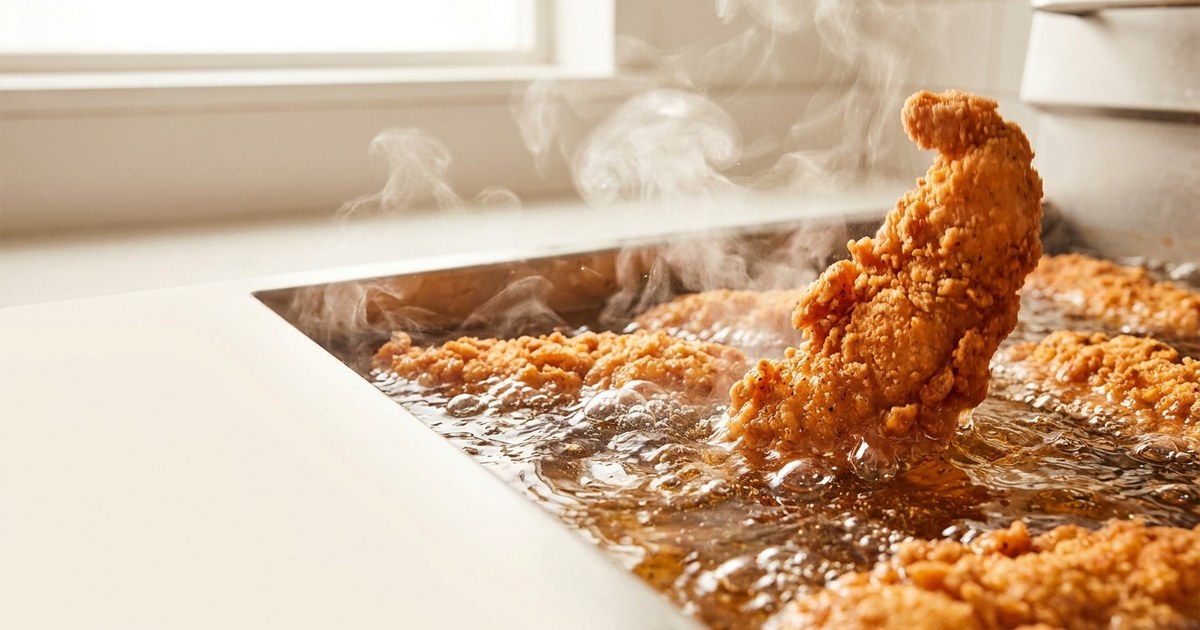
When you dredge chicken in seasoned flour or breadcrumbs, you create a layer packed with starch molecules. Those molecules absorb moisture from the chicken and the air. When the breaded tender hits hot oil (ideally 350°F to 375°F), three things happen at once. The water in the coating turns to steam and escapes. The starch granules swell and gelatinize, forming a rigid structure. The surface undergoes the Maillard reaction, a chemical transformation between amino acids and sugars that creates browning and flavor.
The result is a crispy shell with a savory, slightly nutty taste. But this only works if the breading is fresh. Pre-breaded tenders that sit for hours or freeze lose surface moisture. The coating starts breaking down before it ever sees the fryer. Reheating doesn't restore crispiness: it just makes the shell hard and dry.
The role of starch and flour in creating crunch
Flour-based coatings contain wheat starch and protein. The starch absorbs liquid and puffs when fried, creating an airy texture. The protein (gluten) binds the coating together so it doesn't fall off the chicken. Some recipes for homemade chicken tenders add cornstarch or rice flour for extra crunch because those starches gelatinize faster and create more brittle shells.
Breadcrumb coatings work differently. Panko (Japanese-style breadcrumbs) are made from crustless bread and have irregular, flaky edges. Those edges catch more oil and create sharper, louder crunch. Regular breadcrumbs are denser and produce a finer texture. Either way, the coating has to stick to raw chicken to work. That's why hand-breaded chicken sandwiches are dredged right before frying, when the chicken is still moist enough for the flour or crumbs to grip.
Why frying temperature matters
Temperature controls texture. Too low (below 325°F) and the coating absorbs oil instead of crisping. The tender comes out greasy and soft. Too high (above 400°F) and the outside burns before the chicken cooks through. The sweet spot is 350°F to 375°F, where the oil is hot enough to vaporize surface moisture instantly but cool enough to let the interior reach 165°F without scorching the breading.
Fresh oil matters, too. Used oil has a lower smoke point and leaves a stale, metallic taste on the coating. Restaurants that fry hand-breaded chicken to order filter their oil multiple times a day and replace it regularly. Chains that reheat frozen tenders in high-volume fryers often use the same oil until it breaks down, which is why those tenders taste flat even when they look golden.
How moisture affects crispiness
Crispy and moist sound like opposites, but great crispy chicken tenders are both. The coating is crispy because it's dry on the surface. The meat is juicy because it retains internal moisture. Hand-breading creates that contrast. You coat raw chicken, which is naturally moist, and fry it immediately. The breading crisps while the meat steams inside its own juices.
Frozen tenders lose this balance. Freezing forms ice crystals inside the chicken, which rupture cell walls and release liquid when thawed. That liquid soaks into the coating during reheating, making it soggy. Even worse, most frozen tenders are par-fried at the factory (meaning they're fried once, frozen, then fried again at the restaurant). Each frying cycle dries out the meat and toughens the shell. You end up with a hard coating and dry chicken, the opposite of what you want.
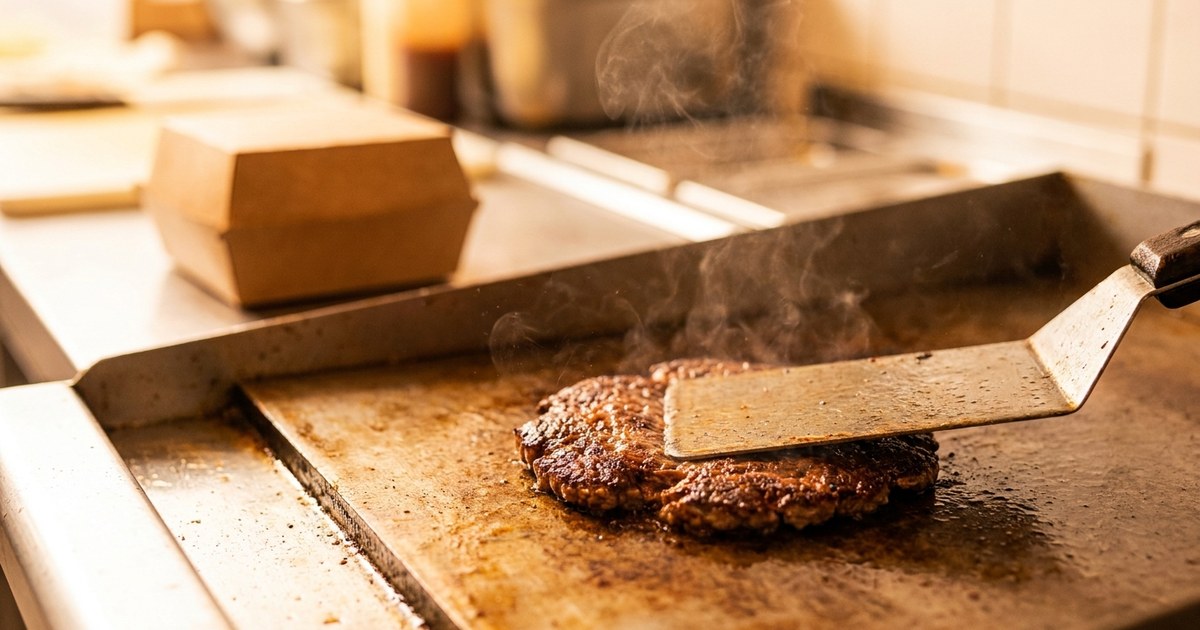
The principle that makes fresh-smashed burgers beat frozen patties applies here. Fresh preparation creates texture you can't replicate after freezing.
Hand-breaded vs. frozen: the real difference
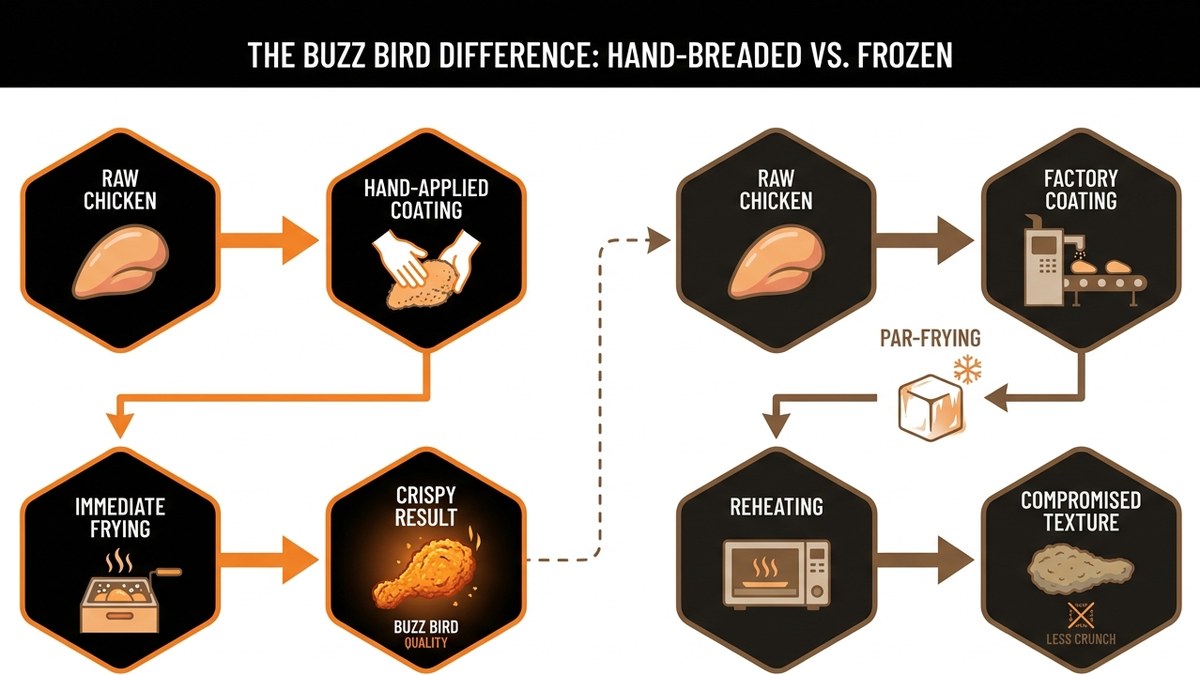
The labels "hand-breaded" and "frozen" describe when the chicken gets its coating, and that timing changes everything.
How frozen tenders are made (factory process)
Frozen chicken tenders start in a processing plant. Raw chicken breast is sliced into strips, tumbled in a marinade or brine, and fed through an automated breading line. First pass: a slurry of flour and water sprayed onto the chicken to help the coating stick. Second pass: dry breading (seasoned flour or breadcrumbs) applied in a rotating drum. Some lines add a third layer for extra thickness.
The breaded tenders are par-fried in industrial fryers, cooked just enough to set the coating but not fully cook the chicken. They're frozen on conveyor belts, bagged, and shipped to restaurants. At the restaurant, they're reheated in a fryer or oven. The whole process is designed for consistency and speed, not flavor.
Why freezing damages texture
Freezing doesn't preserve texture: it locks in whatever state the food was in when it froze. Chicken contains significant water content. When that water freezes, it expands into ice crystals. Those crystals puncture muscle fibers, which is why thawed chicken often releases a pool of liquid in the package. That liquid used to be inside the meat, keeping it juicy.
Breading suffers, too. Moisture from the thawed chicken migrates into the coating during storage and reheating. The coating softens. Even if you refry it, you're crisping a shell that's already compromised. You get a hard crust, not a crispy one. There's a difference. Hard is brittle and dry. Crispy is light and audible: you hear it break when you bite.
How hand-breading preserves moisture and flavor
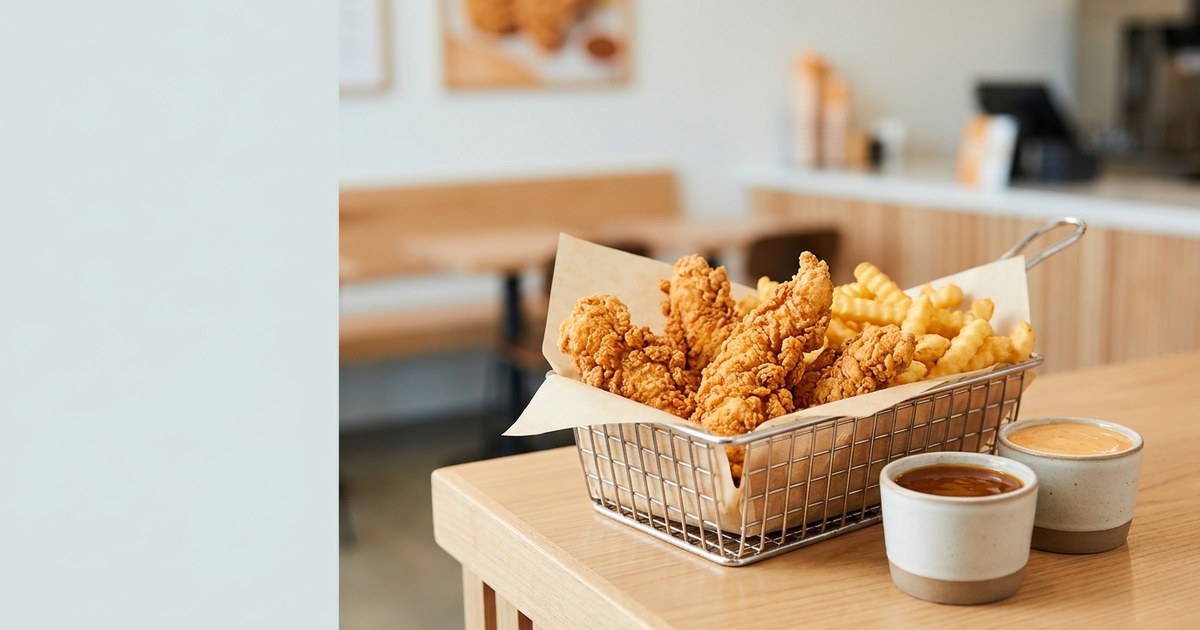
Hand-breaded chicken tenders are breaded raw and fried immediately. The chicken never freezes. The coating never sits. You order, the cook dredges, the tender hits the fryer, and three minutes later it's golden brown and ready.
This process locks in moisture because the chicken is frying from its natural state. The coating forms a seal around the meat, trapping steam inside while the exterior crisps. The seasoning in the flour (salt, pepper, garlic powder, paprika, cayenne, whatever the recipe calls for) stays sharp and distinct because it hasn't been frozen and thawed.
Hand-breading also creates texture variation. A machine applies breading evenly. A human hand presses harder in some spots, lighter in others. That unevenness means some parts of the coating get thicker and crunchier, some parts get thinner and crispier. You get layers of texture in every bite instead of one monotone crunch.
How hand-breaded tenders are made (the craft)
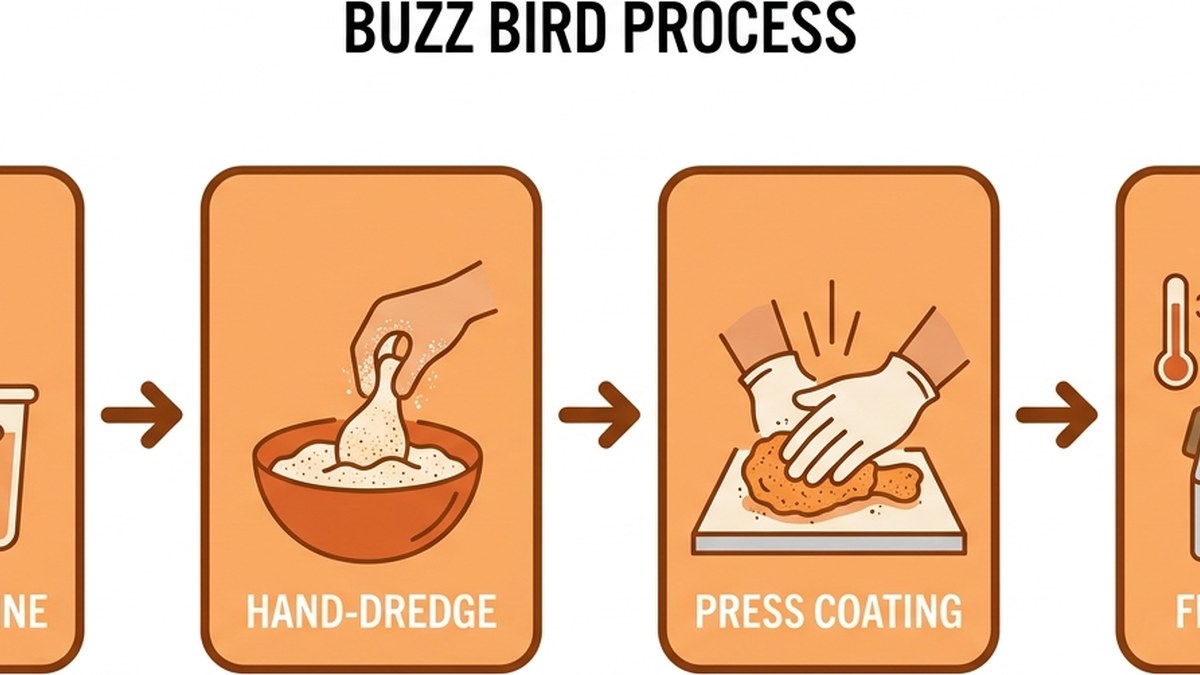
Hand-breading is a four-step process. Every step matters.
Step 1: Brining or marinating the chicken
Great hand-breaded chicken tenders start before the breading. Brining (soaking raw chicken in salted water) seasons the meat from the inside and helps it retain moisture during frying. Salt changes the protein structure, allowing the muscle fibers to hold onto water instead of releasing it under heat.
Some recipes use buttermilk instead of brine. Buttermilk's acidity tenderizes the chicken and adds a subtle tang. The lactic acid breaks down connective tissue, making the meat softer. Either way, the chicken soaks for hours, sometimes overnight. That time investment is non-negotiable. You can't rush seasoning.
Step 2: Dredging in seasoned flour or breadcrumbs
After brining, the chicken is patted dry (not bone-dry, just surface-dry so the coating sticks without clumping). Each tender is dredged in seasoned flour. The flour blend varies by recipe, but the base is always all-purpose flour mixed with salt, black pepper, garlic powder, onion powder, and paprika. Some cooks add cayenne for heat or dried herbs for depth.
The dredging motion matters. You don't just drop the chicken into the flour. You press it in, turn it over, press again. The goal is full coverage with no bare spots. Bare spots mean bald patches after frying, and nobody wants a half-crispy tender.
Some recipes for homemade chicken tenders use a double-dredge technique: dip the floured chicken in buttermilk or egg wash, then dredge again. The second coat adds thickness and creates a shaggy, irregular surface that fries up extra crunchy. It takes more time, but the payoff is real.
Step 3: Pressing the coating for maximum coverage
Once the tender is coated, you press. This step separates amateur breading from professional work. Pressing embeds the flour into the chicken so it doesn't fall off during frying. It also compacts the coating just enough to create structure without making it dense.
You use your palm or fingertips and apply firm, even pressure across the whole piece. You're not squishing the chicken; you're bonding the coating to the surface. The breaded tender should feel slightly tacky, like the flour has melted into the moisture on the chicken.
Hand-breading chicken tenders in small batches means every tender gets individual attention. A cook can feel when the coating is right. A machine can't.
Step 4: Frying to golden brown
The breaded tenders go straight into the fryer. No freezer. No holding tray. Hot oil, 350°F to 375°F, for three to four minutes depending on thickness. You're looking for a deep golden-brown color and an internal temperature of 165°F.
Good fry cooks don't crowd the basket. Too many tenders at once drops the oil temperature, which means soggy coating. They fry in small batches, pull each batch as soon as it's done, and let the oil recover between rounds. The tenders drain on a wire rack (never paper towels, which trap steam and soften the crust).
The same fresh-vs-reheated principle that makes smash burgers taste better when fresh applies to crispy chicken tenders. Immediate cooking from raw ingredients creates a result you can't match with a reheat.
Why you can taste the difference
Texture and flavor are inseparable. When one degrades, the other follows.
Texture: uneven crunch vs. uniform shell
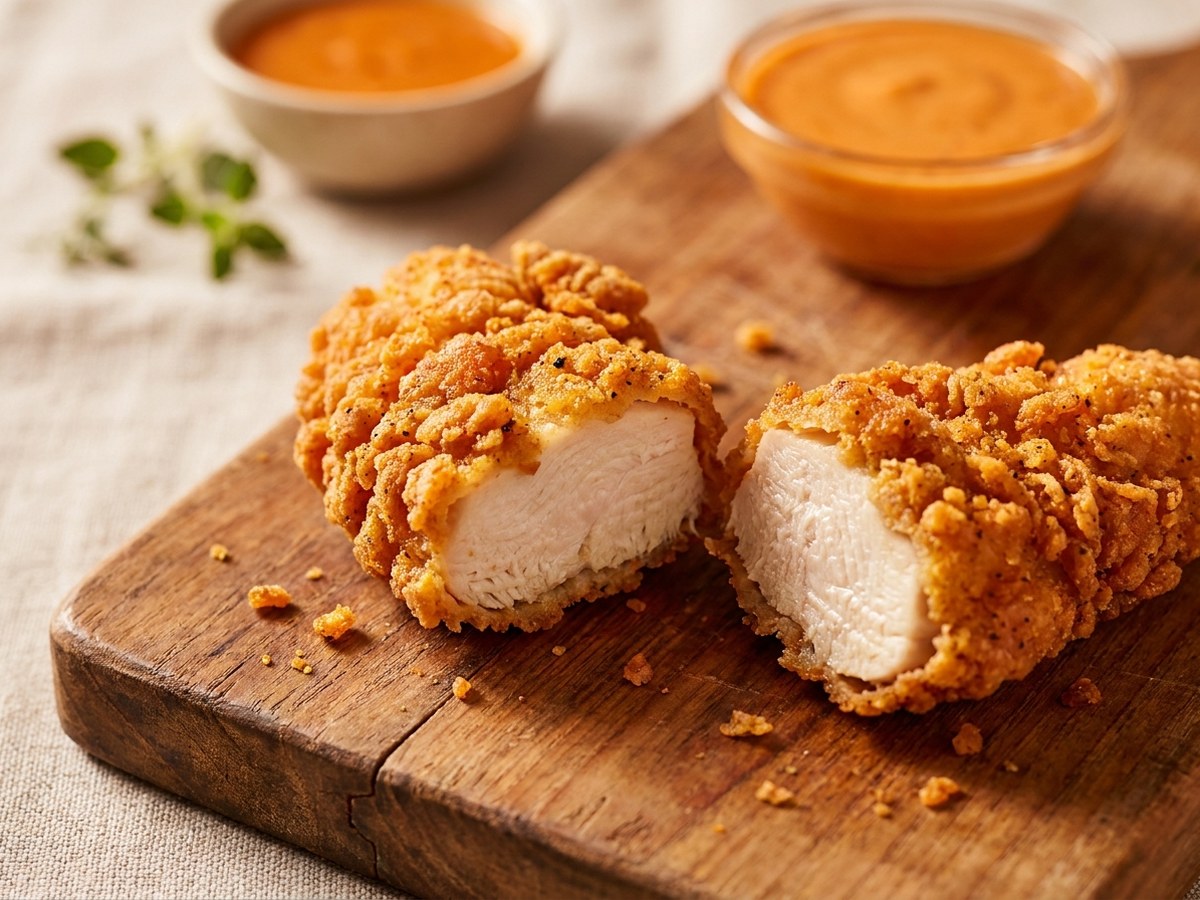
Hand-breaded chicken tenders crunch loud. The coating has peaks and valleys: thick spots where the breading clumped, thin spots where it barely clung. Those variations create contrast. Thick spots shatter. Thin spots crack. Every bite sounds and feels different.
Frozen tenders have a uniform shell. The factory line applies breading evenly, so every piece looks identical. That consistency is the point (chains want predictable portions), but it kills texture interest. You bite once, you've experienced the whole tender. There's no discovery, no progression from crunchy edge to tender middle.
The unevenness in hand-breaded coating also means more surface area. More surface area means more Maillard browning, which means more flavor compounds. A lumpy, irregular crust tastes better than a smooth one because it has more places to develop flavor.
Flavor: seasoning you can see vs. factory salt
When you look at a hand-breaded tender, you see the seasoning. Flecks of black pepper. Orange-red paprika. Tiny herb fragments. The coating is visibly speckled because it was mixed in a bowl and applied by hand. You taste every spice.
Frozen tenders use pre-mixed seasoning blends calibrated for mass production. The flavor is there, but it's muted. Salt dominates because salt is cheap and stable. Pepper, garlic, and paprika fade during freezing and reheating. You end up with a one-note salty crust that tastes the same whether you're in New Jersey or Nevada.
Hand-breaded chicken tenders pair with bold sauces because the coating already has flavor depth. Our house-made sauces amplify the seasoning instead of masking it. Frozen tenders need heavy sauces to taste like anything, and even then, you're tasting the sauce, not the chicken.
Juiciness: fresh meat vs. reheated protein
Fresh chicken, fried from raw, steams inside its coating. That steam is the chicken's own moisture, trapped by the crust. When you bite through the breading, you hit a burst of hot, juicy meat. The contrast is the whole point of a great tender.
Reheated chicken doesn't steam: it dries out. The meat already cooked once at the factory, so reheating just evaporates whatever moisture survived the freezer. You're left with dry, stringy protein inside a hard shell. No amount of sauce fixes that.
People notice. Fast-food prices in New Jersey have climbed in recent years, making the $12 to $16 price point for hand-breaded chicken tenders competitive with national chains. If you're paying chain prices anyway, why settle for chain quality?
What to look for when ordering tenders
Not every restaurant that claims "crispy" delivers it. Here's how to spot the real thing.
Menu language that signals hand-breaded
Look for specific words: "hand-breaded," "made to order," "never frozen," "breaded fresh daily." These aren't just marketing; they're commitments. A restaurant that hand-breads can't make crispy chicken tenders instantly because the process takes time. If the menu says "made to order," expect a five-to-eight-minute wait. That wait is proof you're getting the real thing.
Avoid vague language like "crispy chicken tenders" or "golden fried chicken." Every chain uses those phrases, and most of them serve frozen. If the menu doesn't specify how the chicken is prepared, ask. A good kitchen will tell you exactly how they make it.
Check the rest of the menu, too. Restaurants that hand-bread chicken tenders usually hand-bread other items. If the menu lists hand-breaded chicken sandwiches, fresh-cut fries, or house-made sauces, you're probably in the right place.
Why great tenders take a few extra minutes
Speed and quality live in tension. A restaurant that hands you crispy chicken tenders in 90 seconds is reheating frozen product. There's no other way to hit that speed. Hand-breaded chicken tenders take three to four minutes to fry plus one to two minutes to dredge and prep. Add plating and packaging, and you're looking at six to eight minutes total.
That time gap is a feature, not a bug. It means your food was made for you, not pulled from a warming drawer. If you're ordering takeout or delivery, those extra minutes don't matter: you're already waiting. If you're dining in, the wait gives you time to order a drink or scroll your phone. Either way, the payoff is worth it.
Questions to ask when ordering
When you call or walk in, ask three questions:
If the answer to question one is "frozen," you've saved yourself a disappointment. If the answer to question two is "we bread them fresh throughout the day but not per order," you're getting better-than-frozen quality but not true made-to-order. If the answer to question three is "two minutes," something's off: nobody hand-breads and fries chicken in two minutes.
A confident kitchen will answer all three without hesitation. A kitchen serving frozen product will dodge or deflect.
The best chicken tenders are made fresh, every day
The craft-food movement started with burgers and pizza. Now it's reaching chicken.
Consumers want transparency. They want to know where their food comes from, how it's made, and who's making it. According to the National Restaurant Association's 2026 culinary forecast, made-to-order items and handmade preparations are among the top trends shaping menus. Smash burgers, fresh-cut fries, and hand-breaded chicken tenders are all part of the same shift: people are rejecting factory food in favor of food made by people.
Fresh-never-frozen isn't a gimmick. It's a standard. The same way fresh-smashed burgers beat frozen patties, hand-breaded chicken tenders beat frozen ones because freezing fundamentally changes the product. You can't undo the damage with better reheating.
Fast-casual restaurants that commit to fresh ingredients pay more for labor and throw away less product because they make smaller batches. But they also charge accordingly, and customers pay because the value is obvious. A $14 plate of hand-breaded chicken tenders with fries beats a $10 frozen tender meal every time. You taste the difference in the first bite.
How Buzz Bird hand-breads every tender
We don't take shortcuts. Every crispy chicken tender that leaves our kitchen was raw chicken 24 hours ago.
Here's our process. We source fresh, never-frozen chicken breast. We brine it for 24 hours in a saltwater solution spiked with garlic and black pepper. That brine seasons the meat all the way through and locks in moisture so the chicken stays juicy after frying. While the chicken brines, we mix our breading: all-purpose flour, sea salt, cracked black pepper, garlic powder, smoked paprika, and cayenne. The ratio is dialed in to our taste, and we don't share it.
When you order hand-breaded chicken tenders, we pull a brined tender, pat it dry, and dredge it by hand in the seasoned flour. We press the coating into the chicken, flip it, press again. Then it goes straight into the fryer at 365°F. Three and a half minutes later, it comes out golden brown with an internal temp of 165°F. We drain it on a wire rack, hit it with a pinch of flaky salt, and send it out.
We bread tenders in small batches throughout service. No tender sits longer than 10 minutes between breading and frying. If we run out during a rush, we make more. We don't keep a backstock of pre-breaded chicken because pre-breading defeats the purpose. The coating loses its grip and the flour gets gummy. Fresh means fresh: dredged when you order, fried when you order.
Our family's been cooking chicken this way for generations. Built by family, driven by flavor isn't a tagline. It's how we operate. Every tender that leaves our kitchen reflects that standard. Whether you're ordering tenders with Ya Ya Sauce or pairing them with a Field Guide Dirty Soda, you're getting the same commitment to fresh, hand-made quality in every component.
Conclusion
Hand-breaded chicken tenders aren't complicated. They're just real. Real chicken, real seasoning, real frying: no freezer in between. The difference shows up in every bite: louder crunch, deeper flavor, juicier meat. Once you've had a hand-breaded tender made to order, frozen tenders taste like what they are (reheated shortcuts).
You don't need to settle for chain-food mediocrity. You just need to know what to look for and where to find it. Now you do.
If you're ready to taste the difference, check out our full menu and order now to try hand-breaded chicken tenders near me.