A smash burger is a burger patty pressed flat onto a screaming-hot griddle with a metal spatula the moment it hits the surface. The technique creates a deeply caramelized, lacy crust through the Maillard reaction while keeping the inside juicy. Fresh burger patties perform better than frozen because they smash evenly, release moisture at the right rate for crust formation, and don't steam. They sear. That crust is what makes smash burgers taste better.
You've heard "smash burger" everywhere. On menus. On TikTok. From friends who swear they're better than regular burgers but can't quite explain why. According to the National Restaurant Association's 2026 culinary forecast, smash burgers have surged from niche technique to mainstream obsession in the past few years. So what's the deal? Is this just hype, or is there something real behind the crust?
This guide breaks down the smash technique, the science that makes it work, why fresh burger patties beat frozen, and how to spot a real smash burger when you're ordering out. By the end, you'll know exactly what you're eating and why it tastes so good. At Built by Family. Driven by Flavor., we smash fresh beef to order because we've tested the alternatives and they don't deliver. Here's what we've learned.
What Is a Smash Burger? The Technique Explained
The smash burger technique is simple. Take a ball of ground beef (2 to 3 ounces, room temp, loosely packed). Drop it on a flat-top griddle preheated to 400-450°F. The second it hits the surface, smash it hard with a wide metal spatula. Press down with real force for about 10 seconds until the patty is thin, ⅛ to ¼ inch thick. Leave it alone for 2 to 3 minutes. Don't touch it. Don't move it. Let the crust form. When the edges are brown and crispy, scrape under the patty with the spatula to release the crust from the griddle, flip once, and cook another minute or two. That's it.
The smash is what separates this from every other burger. A regular burger sits on the grill and cooks from the bottom up. A smash burger maximizes contact between beef and metal. More surface area touching high heat means more Maillard reaction. More Maillard reaction means more crust. More crust means more flavor.
Watch this explainer on why smash burgers taste better to see the technique in action. The difference is visible within seconds. The patty spreads thin. The edges start to brown. Steam rises. The griddle sizzles. That sizzle is moisture leaving the beef and turning into crust. The technique forces that transformation. No smash, no crust. No crust, no smash burger.
The Maillard Reaction: Why That Crust Tastes So Good
The Maillard reaction is the chemistry behind browning. When proteins and sugars in beef hit high heat (above 300°F), they break down and recombine into hundreds of new flavor compounds. You taste those compounds as savory, nutty, roasted, caramelized. The reaction happens fast on a flat-top griddle because the metal transfers heat evenly and holds temperature. A smash burger gives you more Maillard surface than a thick patty ever could.
Frozen beef struggles here. Ice crystals inside the patty release water when they melt. That water sits between the beef and the griddle, creating steam. Steam cools the surface. Cooling the surface slows the Maillard reaction. The result is a grey band around the crust instead of deep brown caramelization.
Fresh burger patties have moisture, but it's distributed evenly. When you smash fresh beef, the moisture releases slowly and evaporates fast. The griddle stays hot. The crust forms. America's Test Kitchen's research on the Maillard reaction explains why temperature and surface contact matter more than any other factor when building crust.
Smash Burgers vs. Regular Burgers: What's the Real Difference?
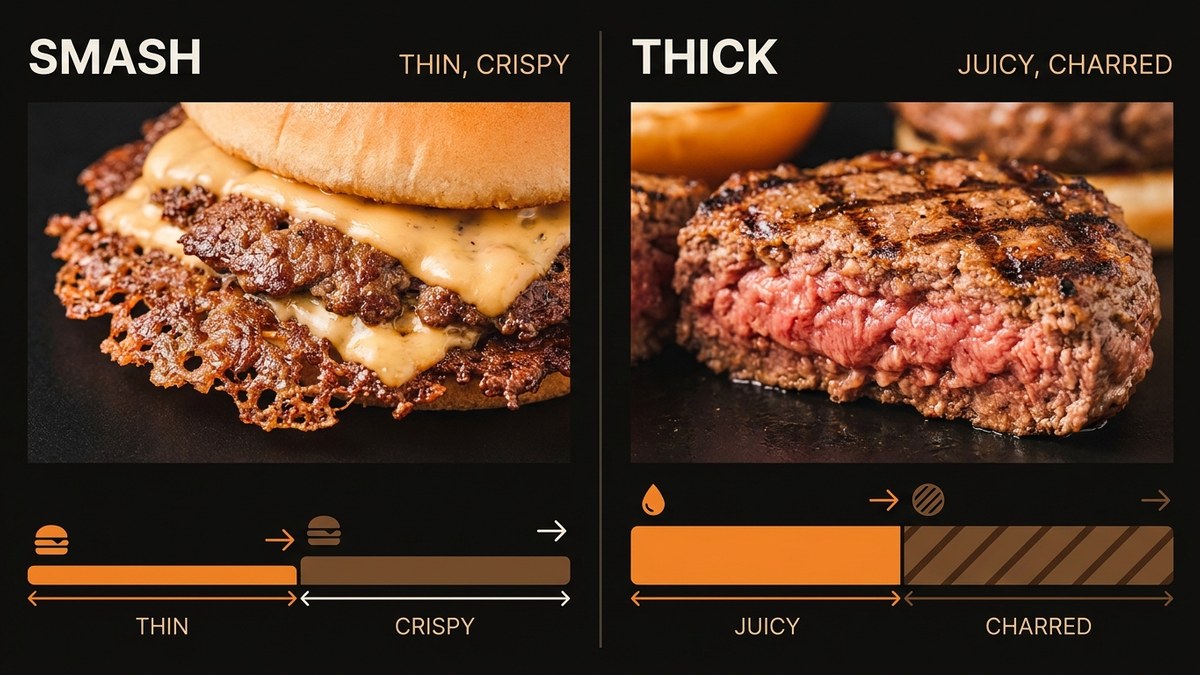
Smash burgers and thick pub-style burgers deliver different experiences. Neither is better. They're built for different goals. Here's how they compare:
Smash burger: Thin patty (⅛ to ¼ inch), high crust-to-interior ratio, crispy edges, fast cook (under 5 minutes total), all the flavor on the surface. You get texture first, juice second. The beef is a carrier for the crust. Cheese melts into the crust. Toppings sit on a flat, stable base. Every bite is crispy.
Thick burger: ½ to ¾ inch thick, char marks from grill grates, medium-rare or medium center, longer cook (8-12 minutes), juice and beefy flavor dominate. You get a contrast between the charred exterior and the soft, pink interior. The beef itself is the star. Cheese melts over the top. Toppings pile high. Every bite is juicy.
Smash burgers work best with American cheese, pickles, onions, and simple sauces. The goal is balance. The crust is bold. The toppings cut through without competing. Thick burgers handle heavier toppings: bacon, blue cheese, aioli, avocado. The interior can carry the weight.
If you want texture and speed, order a smash burger. If you want a steakhouse experience in burger form, order thick. The technique defines the outcome.
Why Fresh Beef Makes Smash Burgers Better
Fresh beef performs better on a flat-top griddle. Here's why. Fresh-ground beef (never frozen) has higher moisture content distributed evenly through the meat. When you smash it, the patty flattens uniformly. The surface makes full contact with the griddle. Moisture releases slowly as the patty cooks, creating steam that escapes fast. The griddle stays hot. The Maillard reaction kicks in within seconds. The crust forms before the interior overcooks.
Frozen beef has ice crystals. When you smash a frozen patty (or a patty that was frozen and thawed), those crystals melt into water. Water pools between the beef and the griddle. The patty steams instead of sears. The surface temperature drops. The crust takes longer to form. By the time the crust browns, the interior is overcooked and dry. You get a grey band around the edges instead of deep caramelization. The texture is mealy. The flavor is flat.
Fresh beef also smashes more evenly. Frozen patties are often pre-formed into pucks. When you press a puck, the edges crack. The center stays thick. You end up with an irregular patty that cooks unevenly: burnt edges, undercooked center. Fresh beef starts as a loose ball. It spreads naturally under pressure. The result is a thin, even patty with lacy edges that crisp up fast.
Restaurant data on smash burger trends shows that establishments prioritizing fresh beef are seeing higher customer satisfaction scores and repeat visits. Diners notice. The crust is darker. The flavor is richer. The texture is crispier. Fresh beef is the difference between a good smash burger and a great one.
What "Fresh" Actually Means (and What It Doesn't)
Fresh beef means never frozen. The beef is ground within 24 to 48 hours of butchering and stored at 28-32°F. It stays cold enough to inhibit bacterial growth but warm enough that water doesn't freeze. That's the technical definition.
Fresh does NOT automatically mean grass-fed, organic, hormone-free, or locally sourced. Those are separate claims. A burger can be fresh and grain-fed. A burger can be fresh and raised on a feedlot. A burger can be fresh and shipped from out of state. "Fresh" is a storage and processing term, not a quality or ethics term.
When a restaurant says "fresh beef," ask what they mean. Do they grind it in-house daily? Do they buy fresh-ground from a supplier? Do they buy pre-formed patties that were never frozen? The closer the grinding happens to the cooking, the better the texture. Fresh-ground beef has a loose, tender texture. Pre-formed patties (even fresh ones) are denser because the meat is compressed. Dense patties don't smash as well.
At Buzz Bird, fresh means ground daily and smashed to order. No prep. No freezer. No shortcuts. Why we brine for 24 hours, not 12 applies the same principle to chicken: time and care beat speed and convenience every time.
The Flat-Top Matters: Why Smash Burgers Need High, Even Heat
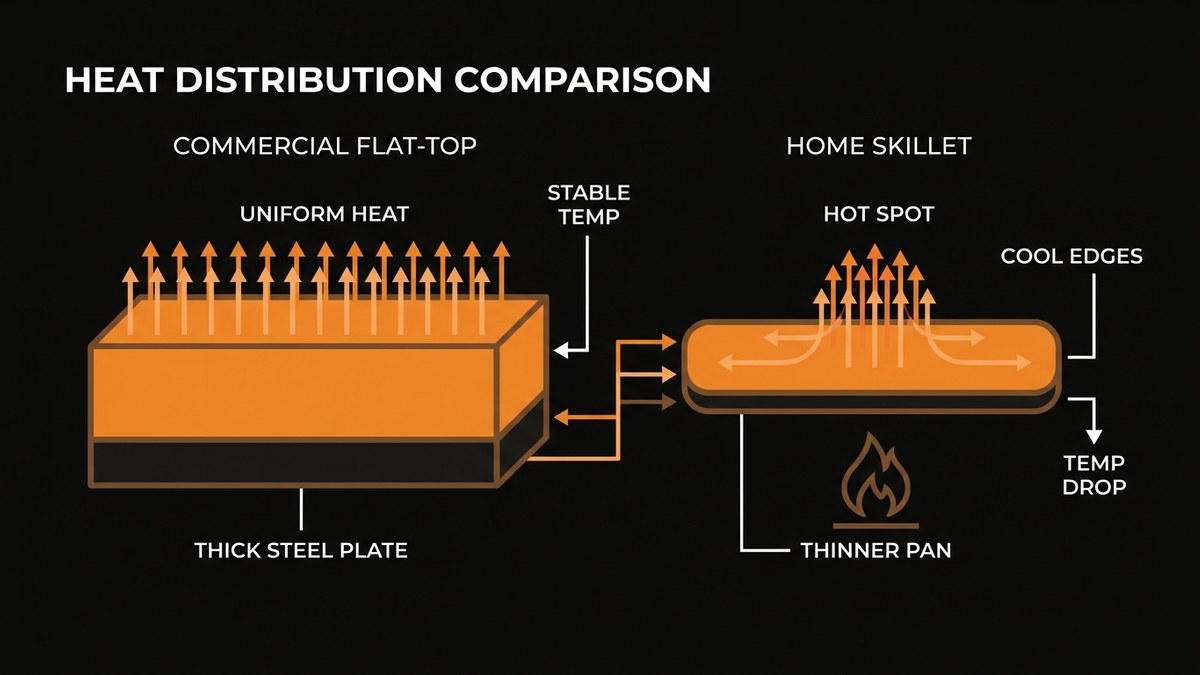
You can't make a real smash burger in a cast-iron skillet at home. You can get close, but the result won't match a commercial flat-top. Here's why. A commercial flat-top griddle is a ¾-inch steel plate heated from below by gas burners. The steel holds temperature at 400-450°F across the entire surface. When you smash a patty onto it, the griddle doesn't cool down. The heat transfers evenly into every millimeter of beef. The crust forms in seconds.
A cast-iron skillet at home is ¼ to ½ inch thick. It heats unevenly. Hot spots form over the burner. Cool spots form at the edges. When you smash a patty in a skillet, the pan loses temperature. It takes time to recover. The crust forms slower. The patty curls at the edges because the center cooks faster than the perimeter. You end up with a burger that's crispy in the middle and soft at the edges (the opposite of what you want).
Commercial flat-tops also have mass. A 50-pound steel plate doesn't lose heat when you press cold beef onto it. A 5-pound skillet does. As local Brick, NJ dining guides note, the quality of equipment directly affects what restaurants can deliver consistently.
If you want to smash burgers at home, use the heaviest griddle or plancha you can find. Preheat it for 10 minutes on high. Use parchment paper between the spatula and the patty so you can press hard without the beef sticking to the spatula. Accept that your crust won't be as dark or as lacy as a restaurant's. The technique is the same. The equipment is the limiting factor. NJ dining trends show that diners increasingly value restaurant-quality results they can't replicate at home, which drives smash burger popularity at fast-casual spots.
How to Spot a Real Smash Burger on a Menu
Not every burger labeled "smash" on a menu is a real smash burger. Here's how to tell the difference before you order.
Look for these signals:
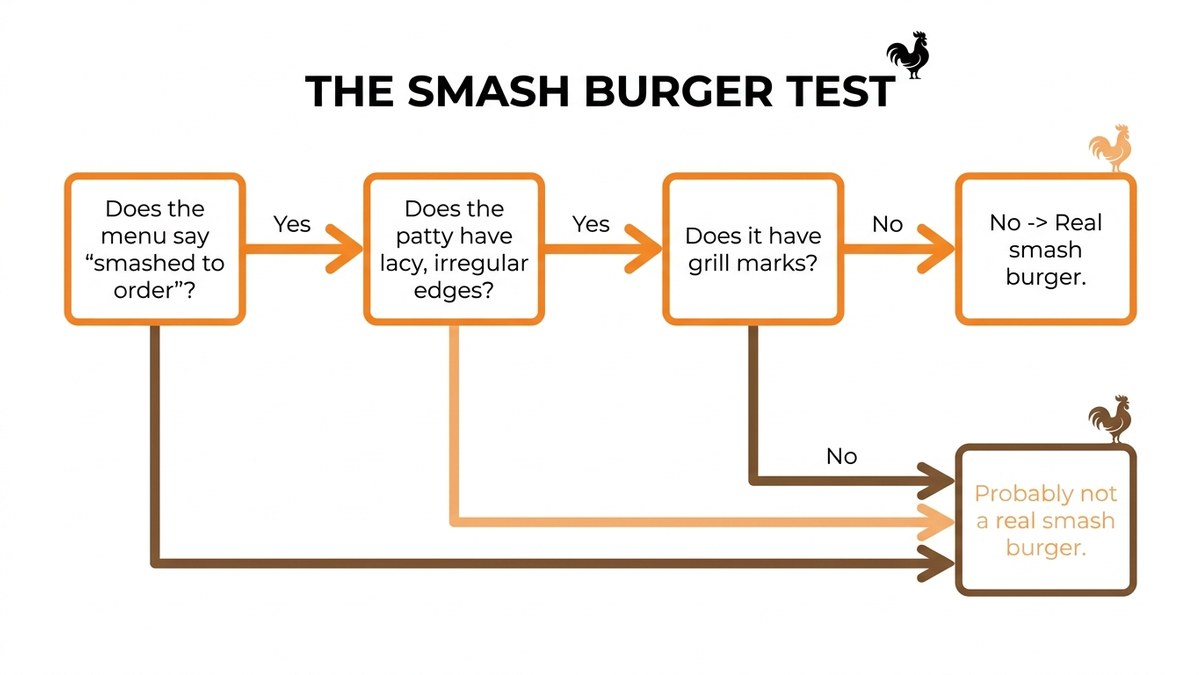
The menu says "smashed to order" or "flat-top seared." The burger arrives with visible crust: dark brown, crispy, irregular edges that look lacy. The patty is thin (you can see through it in spots). The cheese is melted into the crust, not sitting on top. The burger is served fast (under 10 minutes from order to table). The beef tastes deeply caramelized, almost nutty.
Red flags:
The patty is a perfect circle. Smash burgers have irregular, organic edges. Pre-formed patties are uniform. The burger has grill marks. Grill marks come from grates, not a flat-top. A flat-top gives you an even crust, not stripes. The menu says "smash burger" but the cook time is 15+ minutes. Real smash burgers cook in under 5 minutes total. The patty is thick (½ inch or more). That's not a smash burger. That's a regular burger someone pressed lightly.
Ask the server: "Do you smash it to order on a flat-top, or is it pre-formed?" A real smash burger kitchen will answer confidently. If they hesitate or say "I think it's smashed," it's probably not.
At Buzz Bird, every smash burger starts as a ball of beef. You'll see the crust. You'll taste the difference. We also make house-made sauces like Ya Ya to complement the crust without overpowering it. The beef is the star. The sauce is the supporting act.
Why Buzz Bird Smashes Fresh Beef to Order
In our kitchen in Brick, NJ, every burger starts as a ball of fresh-ground beef. We smash it the second it hits the flat-top. No prep. No pre-forming. No freezer. That's how we get the crust our regulars come back for.
Our flat-top runs at 450°F all day. That's the temperature where the Maillard reaction happens in seconds, not minutes. We've tested frozen patties. They steam before they sear. That's why we'll never use them. Fresh burger patties smash evenly. The moisture releases at the right rate. The crust forms fast. The interior stays juicy. The texture is what a smash burger should be: crispy outside, tender inside, no grey band.
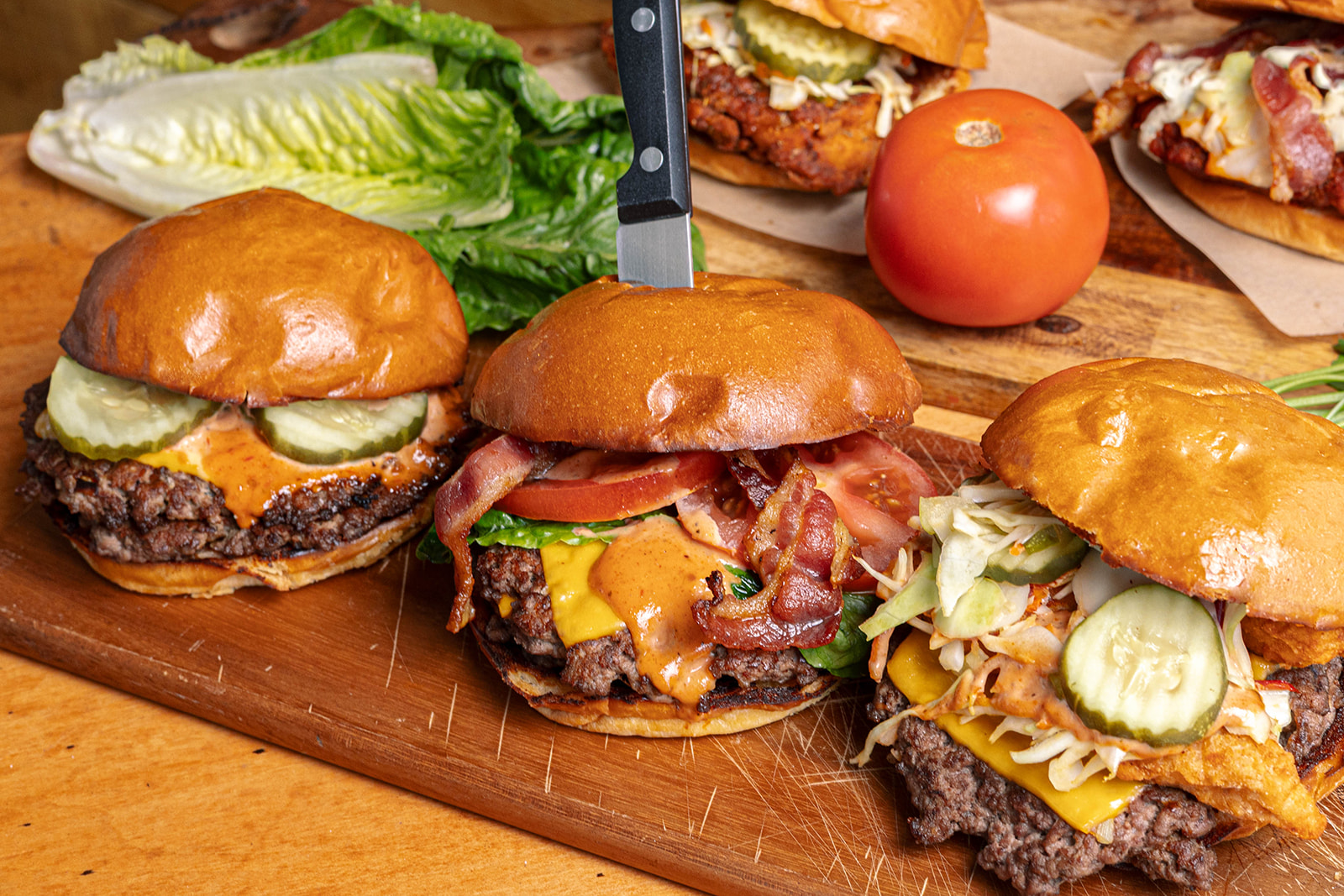
We offer two signature smash burgers: the Buzz Smash'd (American cheese, pickles, onions, Buzz sauce) and the Rt 70 Smash'd (double smash, double cheese, grilled onions, house aioli). Both are built on the same foundation: fresh beef, high heat, hard smash. The same craft approach we take with hand-breaded chicken sandwiches applies to burgers. No shortcuts. No compromises. Every order is made to order.
The National Restaurant Association's 2026 culinary forecast confirms that smash burgers and fresh beef top the list of what diners want. We're not following a trend. We're doing what makes sense. Fresh tastes better. Smashing creates texture. The combination is what you deserve.
Check out our full smash burger lineup and menu to see what else we're smashing. Every patty. Every time. No exceptions. That's our family's approach to food. We wouldn't serve it if we wouldn't eat it ourselves.
Smash Burgers at Home: The Essential Gear & Technique
You can make a solid smash burger at home if you have the right gear and follow the technique. Here's what you need.
Gear:
A heavy cast-iron griddle or carbon steel pan (the heavier, the better). A wide, sturdy metal spatula with a flat edge. Parchment paper squares (so you can press hard without the beef sticking to the spatula). A scale (to portion 2-3 oz balls of beef accurately).
Technique:
Preheat the griddle on high for 10 minutes. You want it screaming hot: 400°F or higher if your stove can manage it. While it heats, portion your beef into 2 to 3 oz balls. Don't pack them tight. Loose beef smashes better. Season generously with salt and pepper on the outside of the ball.
Place a ball on the griddle. Immediately cover it with a parchment square. Press down hard with the spatula. Use both hands if you need to. You're aiming for ⅛ to ¼ inch thick. Hold the press for 10 seconds. Remove the parchment. Leave the patty alone for 2 to 3 minutes. Don't peek. Don't move it. You'll hear it sizzle. That's the crust forming.
When the edges are brown and crispy, slide the spatula under the patty and scrape to release the crust. Flip once. Add cheese. Cook another minute or two. Remove and assemble immediately on a toasted bun with pickles, onions, and sauce. Eat it hot.
Your home version won't be as lacy or as dark as a restaurant's, but the technique is the same. The limiting factor is your equipment, not your skill. Our approach to dirty sodas shows that technique translates across categories: what works for hand-crafting beverages works for smashing.
The Crust Is the Point
Smash burgers are popular because texture matters as much as flavor. The crust is where the Maillard reaction lives. The crust is what you taste first. The crust is what separates a smash burger from every other burger. Fresh beef plus high heat plus the smash technique is the only way to get that crust. Frozen beef doesn't deliver. A thick patty doesn't deliver. A grill doesn't deliver. The flat-top and the smash are non-negotiable.
If you've never tried a real smash burger, you're missing the crispiest, most deeply caramelized burger experience available. If you've tried a mediocre one, you probably didn't get the real thing. Look for the signals: smashed to order, lacy edges, dark crust, fast service. That's what a smash burger should be.
Want to taste the difference fresh beef and a hot flat-top make? Try a smash burger at Buzz Bird in Brick, NJ. Every patty smashed to order, every time.
For more from the Buzz Bird kitchen, explore how we approach every menu item with the same craft-first mindset. Whether it's ranking the most popular chicken sandwiches or learning about hand-breaded chicken sandwiches and why they taste better than fast food chains, the same care goes into every plate. For a complete guide to our approach, check out Best Chicken Sandwiches in Brick, NJ: A Local's Guide.
Check out our full menu and order now